Seat, crate or harness
Dog car seat, crate or harness? How to choose
Dog car seat, crate, seat belt harness or dog guard: how each restrains a dog in the car, which dogs and cars they suit, and what crash tested should mean.
Rule 57 of the Highway Code asks drivers to make sure dogs are suitably restrained so they cannot distract you while you are driving or injure you, or themselves, if you stop quickly. It then names four ways to do it: a seat belt harness, a pet carrier, a dog cage and a dog guard. Dog car seats for small dogs sit somewhere between a harness and a carrier. Which one suits you depends on your dog's size, your car and how you travel. This guide compares them.
We sell dog car seats for small dogs. We do not sell crates, harnesses or dog guards, so this comparison is not a sales pitch for those: use it to decide what your dog needs.
The options at a glance
| Dog car seat | Crate (dog cage) | Seat belt harness | Dog guard | |
|---|---|---|---|---|
| Best for | Small dogs | Dogs of any size that are used to a crate | Dogs of most sizes | Dogs that travel in the boot |
| Where in the car | Passenger seat or centre armrest | Boot or back seat | Back seat | Boot |
| How it restrains | Seat fixed to the car, tether clipped to a harness | Dog inside a closed crate fixed to the car | Harness linked to the seat belt system | Barrier stops the dog coming forward |
| Comfort | Padded, raised, dog can look out | A den with bedding | Dog sits or lies on the seat | Space to lie down in the boot |
| Dog can move about | Within the seat | Within the crate | Within the tether length | Within the boot |
| Takes up | One seat or the armrest | Boot space or a seat | One seat | The boot |
| Watch out for | Size and weight of the dog, front airbags | Fixing the crate so it cannot slide | Fit of the harness | The dog is not tethered inside the boot |
Dog car seats
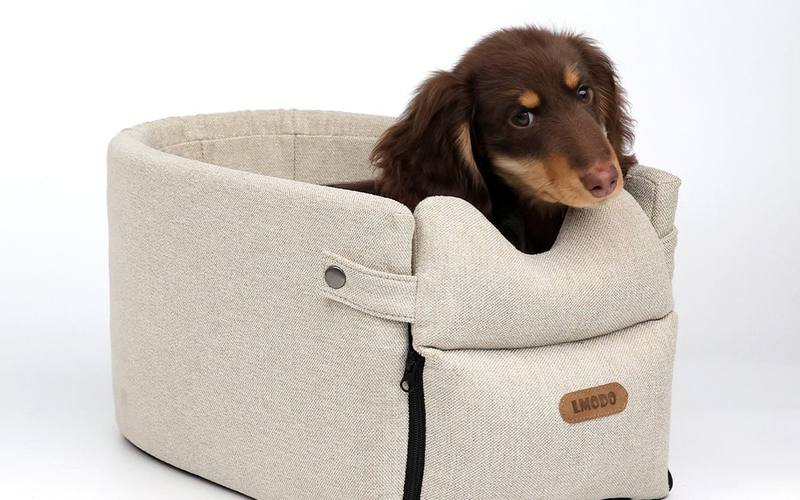
A dog car seat is a padded seat or basket that fixes to a car seat and has a short tether inside. The tether clips to your dog's harness. Small dogs like them because they sit higher and can see out, and owners like that the dog stays in one place instead of wandering across the back seat.
Good for: small dogs, short and medium trips, dogs that settle when they can see you.
Things to check:
- Size. Your dog should be able to sit, lie down and turn round inside. Our booster seat measures 50 x 50 x 30 cm, our covered seat 45 x 43 x 43 cm and our console seat bed 45 x 26 x 23 cm, for pets up to about 6 kg.
- Fixing. A seat should be held by more than its own weight. Our booster seat straps round the seat back, the covered seat uses a headrest strap and the car's seat belt, and the console seat sits on the armrest with an anti-slip base.
- Tether to harness. Vets Now, a UK veterinary emergency service, warns never to attach a seat belt directly to a dog's collar because of the risk of serious injury in a collision. Clip the tether to a harness and keep it short.
- Front seat and airbags. Front airbags are designed for adult passengers. Check your car's handbook before using any pet seat in the front, and use the back seat when you can.
Crates
A crate, or dog cage, is a rigid box with a door. In the car it usually goes in the boot of an estate or hatchback, or on the back seat for a small dog.
Good for: dogs that are already used to a crate at home, longer journeys, dogs that are calmer in a den, cars with a big boot.
Things to check:
- Size. The crate should be big enough for your dog to stand up, turn round and lie down comfortably, but not so big that it slides about inside.
- Fixing. A loose crate can move under braking. Strap it down or fix it in place as the maker describes, and use non-slip bedding inside.
- Getting in and out. Lifting a heavy dog into a high boot is hard work. Ramps help older dogs.
A crate takes up most or all of the boot, and it needs to fit through the boot opening. Measure both before you buy.
Seat belt harnesses
A seat belt harness is a padded harness with a loop or strap that links to the car's seat belt system, either through a clip that goes into the seat belt buckle or by passing the seat belt through a loop.
Good for: dogs of most sizes on the back seat, owners who want something quick to use that takes no space.
Things to check:
- Fit. The harness must fit your dog well, spreading the load across the chest, and should not be confused with a walking harness unless the maker says it is made for car use.
- Length. The strap should let your dog sit and lie down but not reach the front seats or fall into the footwell.
- Never the collar. As above, do not attach a seat belt or tether to a collar.
Dog guards
A dog guard is a mesh or bar barrier between the boot and the back seats. The dog travels loose in the boot, but cannot come forward into the cabin.
Good for: larger dogs and estate cars, several dogs travelling together, owners who need the back seats for people.
Things to check: fitting (some guards are made for one car model, others are adjustable), and whether the boot is ventilated and shaded on warm days. A dog guard stops your dog coming forward, but the dog is not tethered inside the boot.
What crash tested should mean
Some products are sold as crash tested. That can be a useful sign, but only if the claim says which test the product passed, at what weight of dog and who carried it out. A vague claim without details tells you very little. If crash performance matters to you, ask the maker for the test details before you buy.
Our dog car seats are not crash tested, and we do not claim that they protect a dog in a collision. They are made to keep a small dog in one place on the seat, which is the distraction side of Rule 57.
Which should you choose?
- A small dog that likes to see you: a dog car seat on the back seat, or a console seat on the armrest, with the tether clipped to a harness.
- A small dog that is nervous in the car: a covered seat or a carrier, which gives it a den with mesh windows.
- A medium or large dog on the back seat: a seat belt harness made for car use.
- A dog that is used to a crate, or a long trip: a crate fixed in the boot or on the back seat.
- A large dog in an estate car, or several dogs: a dog guard, or crates in the boot.
Whatever you choose, introduce it at home first, then on short trips. Our guide Travelling with a dog in the car covers Rule 57 in more detail, plus food, breaks, heat and car sickness.
You can compare our three seats side by side on the dog car seats page.
Frequently asked questions
Which is safest for a dog in the car: a seat, a crate or a harness?
It depends on the dog, the car and the product. Rule 57 of the Highway Code accepts a seat belt harness, a pet carrier, a dog cage or a dog guard. If crash protection matters to you, look for products that say which crash test they passed and who carried it out.
Is a dog car seat enough on its own?
A dog car seat should be fixed firmly to the car and used with its tether clipped to your dog's harness. On its own, without the tether, a dog can jump out of it.
Can a big dog use a dog car seat?
Most dog car seats, including ours, are made for small dogs. Medium and large dogs are better served by a seat belt harness on the back seat, a crate or the boot behind a dog guard.
Are your dog car seats crash tested?
No. Our seats keep a small dog in one place on the seat. We do not claim that they protect a dog in a collision.