Dogs in the car
Travelling with a dog in the car: Rule 57 and practical tips
What Highway Code Rule 57 says about dogs in cars, how to restrain a dog, where it should sit, food, breaks, heat and car sickness, with RSPCA advice.

Dogs go everywhere with us: to the vet, to the park, to the coast and on holiday. A dog that is settled and secure in the car makes the trip safer for everyone. A dog that roams around the car, climbs into the front or stands on your lap is a distraction, and if you brake hard it can be thrown forward. This guide explains what the Highway Code says and how to make car journeys calmer and safer.
What Rule 57 of the Highway Code says
Rule 57 is in the section of the Highway Code about animals. It reads:
When in a vehicle make sure dogs or other animals are suitably restrained so they cannot distract you while you are driving or injure you, or themselves, if you stop quickly. A seat belt harness, pet carrier, dog cage or dog guard are ways of restraining animals in cars.
Two points are worth knowing:
- It is advice, not a MUST rule. The Highway Code marks legal requirements with the words MUST or MUST NOT. Rule 57 does not use them.
- It still matters. The introduction to the Highway Code says that failing to follow the other rules will not in itself cause a person to be prosecuted, but that the Highway Code may be used in evidence in court proceedings under the Traffic Acts to help establish liability. A loose dog that distracts a driver is exactly what Rule 57 is about.
The four ways to restrain a dog
Rule 57 names four options. Each suits different dogs and cars:
- Seat belt harness: a harness that links to the car's seat belt system. It suits dogs of most sizes on the back seat.
- Pet carrier: a closed carrier fixed in the car. It suits small dogs and cats.
- Dog cage: a crate in the boot or on the back seat, fixed so it cannot slide.
- Dog guard: a barrier between the boot and the seats, so a dog travelling in the boot cannot come forward.
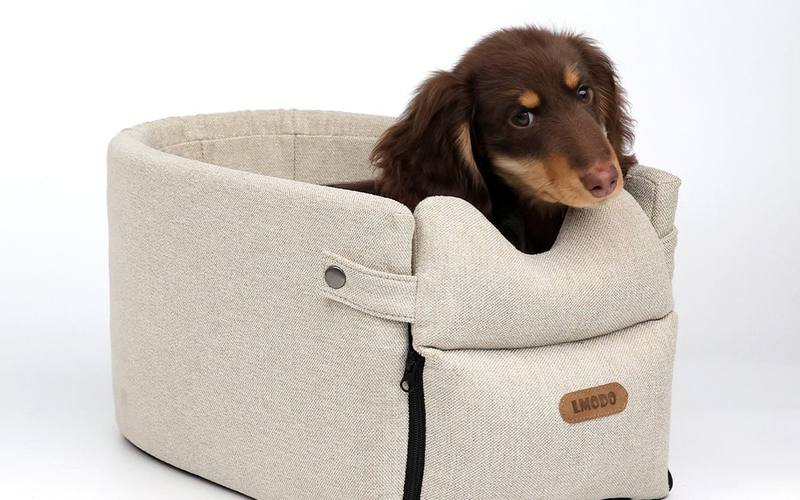
A dog car seat for a small dog combines a raised, padded seat with a short tether that clips to the dog's harness. Our covered dog car seat works much like a soft pet carrier that straps to the seat. Our guide Dog car seat, crate or harness? compares the options in more detail.
Setting up a dog car seat
If you use a car seat for a small dog, set it up carefully:
- Fix the seat firmly. Use every strap it has. Our booster seat straps round the back of the car seat. Our covered seat uses a strap round the headrest and the car's seat belt. Our console seat bed sits on the centre armrest with an anti-slip base, so check it stays put on your car's armrest before you set off.
- Clip the tether to a harness, not a collar. Vets Now, a UK veterinary emergency service, warns never to attach a seat belt directly to a dog's collar because of the risk of serious injury in a collision. A well-fitted harness spreads the load across the chest.
- Keep the tether short. Your dog should be able to sit, lie down and turn round, but not climb out of the seat, reach your lap or get near the pedals and gear stick.
- Think about the front seat. The Highway Code does not ban dogs from the front, but front airbags are designed for adult passengers. Check your car's handbook before you put any pet seat in the front, and use the back seat when you can.
None of our car seats is crash tested, and we do not claim that they protect a dog in a collision. What they do is keep a small dog in one place, which is what Rule 57 asks of you.
Before you set off
- Food: the RSPCA advises feeding your dog no sooner than two hours before you travel, and bringing food along if the trip runs over a normal meal time.
- Toilet and exercise: a walk before you leave helps your dog settle.
- Water: the RSPCA says to provide access to water throughout the journey. Pack a bottle and a bowl.
- ID: make sure your dog's microchip details are up to date before a trip away from home.
- Bring familiar things: a blanket from home in the car seat smells of home and can help a nervous dog settle.
On the road
- Take regular breaks. The RSPCA advises regular breaks so your dog can go to the toilet and stretch its legs. Stop somewhere safe and keep your dog on a lead when you let it out.
- Keep the car cool and ventilated. The RSPCA says the car should be well ventilated and kept cool during the journey. Sun shades on the rear windows help on bright days.
- Keep heads inside. A dog with its head out of the window is not restrained in the way Rule 57 describes, and it is exposed to dust, insects and passing objects. Open the windows only as far as your dog cannot get its head out.
- Stay calm. Speak calmly and do not turn round to deal with your dog while driving. If your dog needs attention, stop somewhere safe first.
Never leave a dog in a hot car
This is the one rule with no exceptions. The RSPCA says never to leave your dog alone in a car on a warm day, even for a few minutes, and warns that a car can reach 47°C within an hour when it is 22°C outside. It also points out that you cannot judge whether a dog in a car is safe just from the temperature outside.
If you see a dog in a hot car showing signs of heatstroke, the RSPCA's advice is to call 999 straight away.
Plan your stops so that you never have to leave your dog in the car: take it with you, or travel with someone who can stay with it outside the car.
Car sickness and nervous dogs
Some dogs are sick in the car or find journeys stressful. The RSPCA's travel advice is to speak to your vet if your pet gets travel sick, and to consider a vet check before a long journey. In the meantime, these steps often help:
- Feed no sooner than two hours before the journey.
- Keep the car cool, with fresh air coming in.
- Start with short, calm trips that end somewhere your dog enjoys, such as a walk.
- Give your dog a secure, comfortable place to sit, such as a car seat with familiar bedding.
Do not give your dog any medicine for car sickness without speaking to your vet first.
Cleaning up after a journey
Car trips bring mud, hair and the odd accident. Removable or wipe-clean surfaces make life easier. The covers of our console seat bed unzip, the supplier describes our booster seat as detachable and washable, and the outer fabric of our covered seat is described by the supplier as waterproof, so most dirt wipes off. Vacuum out hair after long trips.
A short checklist
- Dog restrained as Rule 57 describes: seat belt harness, carrier, cage, guard or a fixed car seat with a tether to a harness
- Tether clipped to a harness, never to a collar
- Back seat where possible, and the car handbook checked before using the front
- Food no sooner than two hours before the trip, water packed
- Regular breaks on longer journeys
- Car kept cool and ventilated, and the dog never left alone in a warm car
You can compare our seats on the dog car seats page. At home, a comfortable bed of its own helps a dog rest after a long trip: see our pet beds.
Frequently asked questions
Is it illegal to have a dog loose in the car in the UK?
Rule 57 of the Highway Code says you should make sure dogs are suitably restrained so they cannot distract you or injure you, or themselves, if you stop quickly. It is not one of the rules marked MUST, but the Highway Code introduction says the other rules can be used in evidence in court proceedings under the Traffic Acts.
What counts as suitably restrained?
Rule 57 gives four examples: a seat belt harness, a pet carrier, a dog cage or a dog guard. For a small dog, a dog car seat with its tether clipped to a harness keeps it in one place on the seat.
Can I leave my dog in the car for a few minutes?
Not on a warm day. The RSPCA says never to leave a dog alone in a car on a warm day, even for a few minutes, and warns that a car can reach 47°C within an hour when it is 22°C outside.
My dog gets car sick. What can I do?
Feed your dog no sooner than two hours before you travel, as the RSPCA advises, keep the car cool and well ventilated and take breaks. If your dog is often sick in the car, speak to your vet.